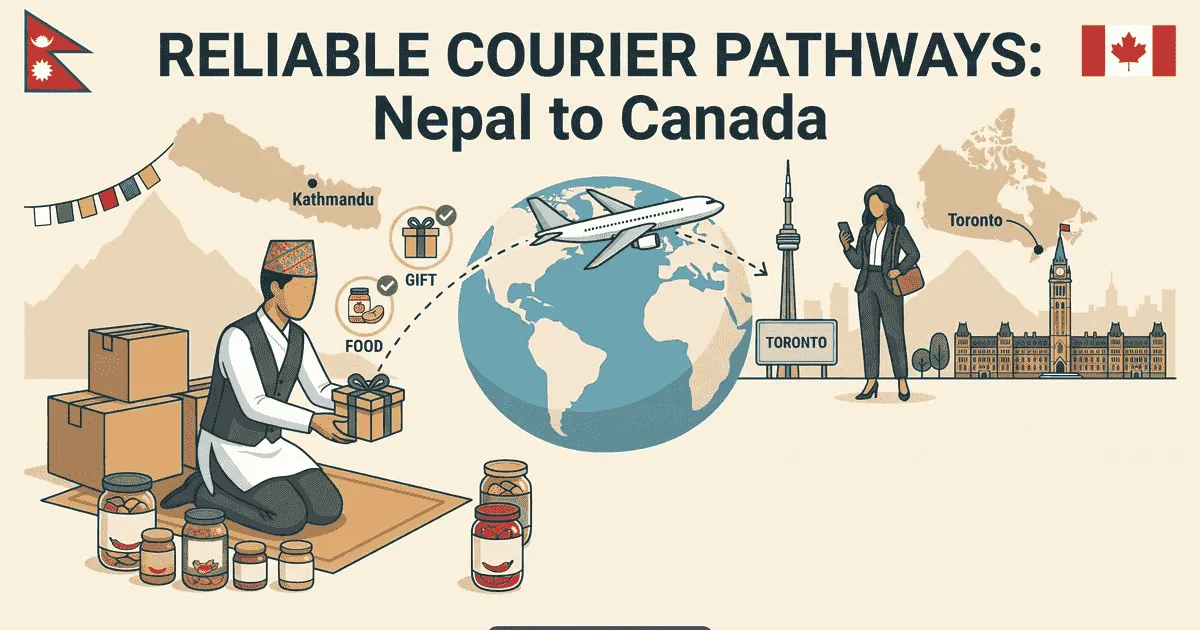
Your GIC receipt needs to be in a bank’s hands before your study permit file is even looked at. Your police clearance certificate has an expiry date attached to it. Your college wants an original transcript, not a scan, and it wants it before the intake closes. None of these are gifts, and none of them care what a courier’s average transit time usually looks like — they care whether the envelope lands before a date that isn’t moving. That’s the story behind most Nepal-to-Canada shipments: Canada is the busiest destination out of Kathmandu on Hyre right now, and it isn’t because of birthday presents. It’s documents, and documents run on deadlines, not patience.
So the real question on this route isn’t just “how much” — it’s “how much, and will it clear in time.” Here’s the number first: a 1 kg document envelope to Canada starts from 6,802 NPR on Hyre, landing in 3–5 days on the fastest service. A 1 kg parcel of goods starts from 4,900 NPR — cheaper on paper, but it rides in 10–14 days, and that gap is exactly where a study permit deadline gets missed. Keep reading, because the next few things — the CAD 20 threshold nobody expects, and how the Canada Border Services Agency actually treats a stamped envelope versus a taped box — decide whether your shipment moves at document speed or parcel speed.
Why the document lane is cheaper and the parcel lane is slower
4,900NPR(parcel)
That gap between 6,802 NPR and 4,900 NPR looks backwards until you know why it exists. A sealed envelope of paper gives CBSA almost nothing to inspect, so it moves through a lane built for speed. A parcel — clothes, gifts, anything with volume and mixed contents — gets weighed, assessed and potentially opened, and that takes the time a document never has to spend. Weight, contents and which vendor you pick still move the exact number, and Canada being the highest-volume route out of Nepal means more vendors are actively quoting it — worth comparing rather than booking the first price you see. But the lane you’re in matters more than the vendor you pick, because so much of what moves to Canada from Nepal is exactly the kind of envelope that belongs in the fast lane, and a surprising number of people send it as a slow parcel anyway.
Getting the document into the right lane, in the right order
Ask any vendor which route gets the most “this has to arrive by Friday” calls, and Canada wins. IRCC deadlines, a college’s document verification window, a GIC confirmation a bank needs physically stamped — none of it moves if the envelope is stuck at a sorting hub because someone booked it as a parcel by mistake, or added one thing that wasn’t paper. Staying in the fast lane comes down to five decisions, made in this order:
Confirm exactly what the institution or IRCC wants
A university portal upload and a physically couriered original are not the same requirement. Read the actual instruction before booking anything — resending because the first envelope had the wrong document costs more time than it ever saves in money.
Keep it paper-only and declare it as documents
One non-paper item in the envelope — a USB stick, a small gift, a coin — reclassifies the whole thing as a parcel, priced and processed differently and slower.
Book express, not economy, when a date is attached
Economy is fine for a parcel that can arrive whenever. A document tied to an intake deadline should never ride the slow service to save a small difference in price.
Track it and keep the waybill number somewhere obvious
An admissions office or IRCC officer asking whether something arrived is a question a tracking number answers immediately. A guess, or 'it should be there by now', answers nothing.
Build in slack beyond the quoted transit estimate
The transit time on a quote is the courier’s number, not CBSA’s. Border processing sits outside that estimate entirely, so send earlier than the deadline feels like it requires.
Documents are the fast, straightforward half of this corridor. But not everything headed to Canada is paper — sooner or later someone’s also sending a shawl, a gift, something with real value tucked in beside the transcripts. That’s where a different number starts to matter, and it’s smaller than most people assume.
Canada’s CAD 20 gift threshold is tighter than you’d guess
That threshold catches people who’d never think of a shawl or a bag of dried fruit as “dutiable.” It usually isn’t worth anyone’s time to collect a few dollars of duty on something small, but a parcel with real declared value — electronics, jewellery, anything a customs officer would actually price — is a different conversation. Declare it honestly. An accurate, itemised declaration is the biggest thing you control over whether a parcel clears quickly or gets pulled for a closer look.
Freight and duty are billed by two different parties at two different times, which is worth saying plainly because it’s the thing people mix up most: the freight charge is what you pay Hyre’s vendor when you book. Duty, where CBSA assesses it, is collected from the recipient in Canada on delivery — a separate bill, from a different party, at a different time. Our guide to who pays customs duty on a parcel from Nepal walks through how that valuation works corridor by corridor.
Value isn’t the only thing CBSA scrutinises, though. The other place this corridor trips people up has nothing to do with what something’s worth, and everything to do with what it is.
Food is the other place this corridor trips people up
Clothes, pashmina, dhaka topi, handicrafts, books, sealed packaged snacks and documents all move without much friction. Food is where CBSA is genuinely stricter than most Nepali senders expect — meat and meat products, dairy, and many fresh, home-preserved or unlabelled items are restricted or outright prohibited, and that includes things that feel completely ordinary to pack: a jar of homemade achar, dried meat, fresh vegetables tucked in with clothing.
Commercially sealed, clearly labelled packaged food has a real chance of getting through where its homemade equivalent won’t. If in doubt, leave it out — a held food parcel usually isn’t worth the delay to everything packed around it. Nepal’s own export restrictions apply on top of whatever Canada disallows; the full list is in what you can’t ship from Nepal.
Once the envelope or box is packed right, declared honestly and priced against the live table above, the rest is the same routine as any other corridor Hyre runs — entering the destination and weight, verifying your ID, paying via eSewa, Khalti, ConnectIPS or cash to the vendor, and getting a waybill number to track it the rest of the way. If you haven’t booked with Hyre before, the full walkthrough covers that part step by step.
How much does it cost to send a parcel from Nepal to Canada?
It depends on weight, contents, vendor and whether you book economy or express — check the live rate table on this page for current figures. Documents are priced separately and are typically the cheapest and fastest thing you can send, since a sealed envelope of paper gives CBSA far less to assess than a mixed parcel.
Is there a duty-free allowance for gifts sent to Canada?
Yes, but it's smaller than people expect: CAD 20 for a genuine gift sent between individuals. Above that, the Canada Border Services Agency can assess duty and GST (plus provincial HST in some cases), billed to the recipient in Canada rather than to the sender at booking in Nepal.
Can I courier study permit or visa documents to Canada quickly?
Yes — declare the shipment as documents specifically, keep anything that isn't paper out of the envelope, and book express rather than economy if a deadline is attached. Track it from the moment it ships, since a waybill number is the fastest way to answer an admissions office or IRCC asking whether something arrived.
Can I send homemade achar or dried meat to Canada?
Be cautious. Canada Border Services Agency restricts or prohibits many meat, dairy and unlabelled food items, and that includes things that feel routine to pack, like homemade achar or sukuti. Commercially sealed, clearly labelled packaged snacks have a much better chance of clearing than anything homemade and unmarked.
How long does a parcel take from Nepal to Canada?
Transit depends on the vendor and whether you choose economy or express — check the specific estimate shown against each quote at booking. Add buffer on top of that figure for border processing, which sits outside the courier's own transit estimate, especially for anything tied to a hard deadline.
- #parcel from nepal to canada cost
- #courier nepal to canada
- #nepal to canada
- #send documents to canada
- #international shipping