Somewhere in Kathmandu right now, someone is packing a birthday gift for a cousin in Delhi and writing “gift” on the customs form, assuming that word does what it does on a UK or UAE shipment: waves the parcel through untaxed. On this corridor, it doesn’t. India goes further than simply not exempting gifts — a parcel declared as a gift can be refused entry outright unless the full duty is paid on it, gift or not. That single fact changes more about how you should pack and price a shipment to India than air-versus-road ever will, and it’s exactly the part most senders find out about only after their parcel is stuck at the border.
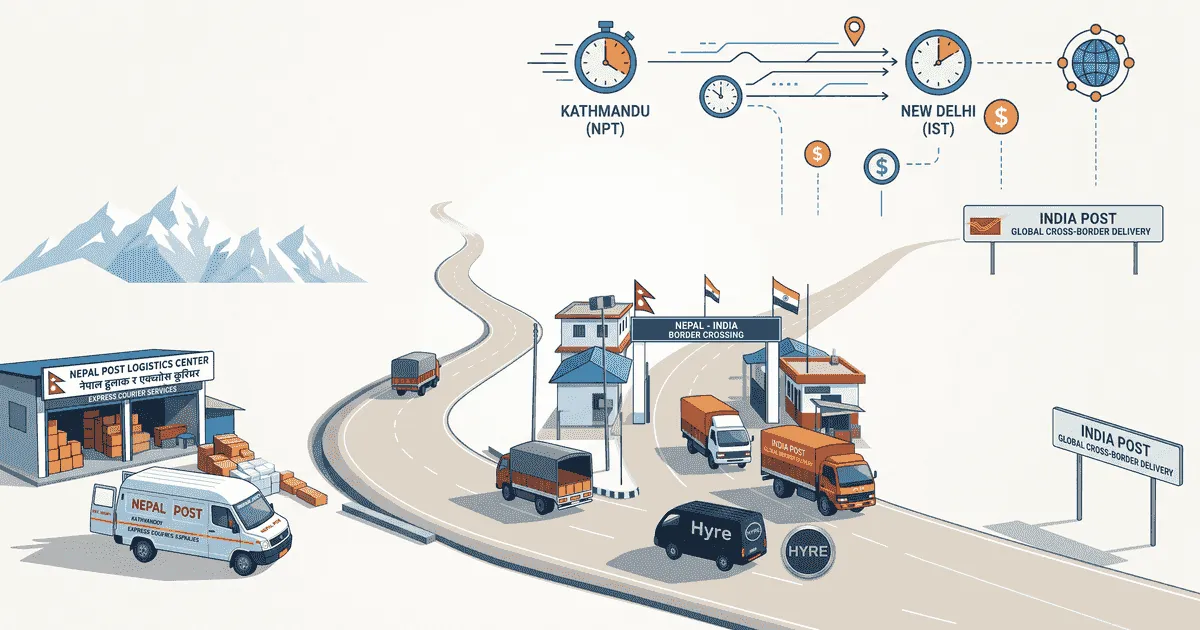
The good news is that Nepal-India is also the one corridor where you get a real choice of route — air, or road across the open border at Birgunj or Kakarbhitta — and that choice is where most of the price actually comes from. A 1 kg parcel to India starts from 6,802 NPR on Hyre, the full freight charge with nothing added later. Air is faster and costs more; road gets markedly cheaper the heavier the shipment gets, which is why household goods and trade consignments travel by road and exam papers fly. Get the route right and you’ve solved the freight side. What decides whether your parcel clears without a surprise bill is everything that happens after it crosses the border — and that’s the part worth reading closely before you pack.
What decides the price: weight, route and destination city
Weight, contents, vendor, service speed and destination city all move the number. Delhi and Kolkata are the two most common India-side destinations for Nepal-origin shipments, largely because of where the border crossings sit, and routing can differ between them.
6,802NPR(parcel)
The documents column is worth a look on its own. A very large number of Nepali students are at Indian universities — Darjeeling, Delhi, Bangalore, Kolkata — and the shipments that corridor generates are small and frequent rather than annual and sentimental. Exam papers, mark sheets, a replacement ID, a bank document a parent has to sign. Those move as documents, priced as paper, and that’s usually the cheapest thing you can send.
Rates and transit estimates shift with each vendor’s capacity and with conditions at the crossings, so the table above carries the time it was last refreshed rather than pretending to be a fixed price list. For the live quote on your shipment, check Hyre. Documents settle the cheap end of this corridor; the more interesting decision is what happens once you’re shipping actual goods, and that’s a choice between two very different routes.
Air or road: which one should you pick?
Road cargo across the land border is generally the cheaper option for anything heavy — bulk household goods, furniture, a relocation, a trade consignment of garments or handicrafts. The tradeoff is days, not hours, and the crossing itself adds steps that an airport doesn’t.
Air courier costs more per kilogram but the gap narrows sharply on small, light parcels, and on a light shipment you’re mostly paying for speed you’d have wanted anyway. The rough rule people who ship this corridor regularly use: if it’s small and it matters when it arrives, fly it; if it’s heavy and the date is soft, put it on the road.
Commercial shipments are a real part of this corridor in a way they aren’t for the UK or Gulf routes — India is Nepal’s largest trading partner by a wide margin, and sample consignments of garments, handicrafts and agricultural goods move constantly. If that’s what you’re sending, the cargo versus courier guide covers where the line between the two services actually falls. But whichever route you pick and whatever you’re shipping, the same thing waits for it on the other side of the border: Indian customs, and it treats “gift” very differently from how the UK or UAE do.
Customs duty on parcels to India — and why “gift” doesn’t help you here
Read this bit before you pack, because it’s the part of this corridor that catches people out hardest.
On the UK corridor, a genuine gift under a set value clears duty-free. On the UAE corridor, a personal-use allowance does something similar. India runs the opposite rule entirely: a parcel declared as a gift isn’t just taxed anyway — customs regulation prohibits importing goods labelled as gifts through courier or post in the first place, with narrow exceptions like life-saving drugs. A gift can still be sent, but only by declaring its real value and paying full duty on it, the same as any commercial import. There’s no ₹5,000 or any other threshold under which it slips through — that specific assumption is one customs guidance directly rules out.
For the general mechanics of how duty is valued and who gets billed, see our guide to who pays customs duty on a parcel from Nepal. There’s one way to bring that rate down, though it only applies to goods of Nepali origin — and it depends on paperwork you have to arrange before the parcel ever leaves Kathmandu.
The certificate of origin
Nepal and India have a bilateral trade treaty, and goods of Nepali origin can qualify for a preferential duty rate under it — but only against a certificate of origin, issued by the trade body Nepal’s government designates for the purpose, not something a courier can produce on your behalf. Without one, the standard rate applies instead. This is a genuinely India-specific mechanic with no equivalent on the Gulf or UK corridors, and it’s worth arranging with the issuing body before dispatch on anything commercial, because it can’t be produced after the goods are already at the border.
Certificate arranged or not, one more thing decides whether a parcel to India moves cleanly or gets held: what’s actually inside it.
What can you send to India?
Clothes, packaged and shelf-stable food, books, documents, electronics for personal use, handicrafts and general household items all travel on this corridor routinely. The restricted end of the list splits into two categories that people tend to blur together, and the difference matters.
Seeds, plants and homegrown produce are the category worth calling out separately. The border being open and familiar makes people assume a packet of seeds or a sapling travels the way it would between two districts of Nepal. It doesn’t — the Nepal-India trade treaty itself commits both governments to requiring phytosanitary certificates on agricultural goods rather than waiving them, and without one, confiscation at the border is the stated risk. Confirm the requirement with your vendor and Nepal’s plant quarantine office before you pack anything grown, not shipped.
For the fuller picture of what’s restricted across Nepal’s busiest corridors, see what customs actually allows in the UK, Dubai, India and Australia.
Pack it right, declare it honestly, and arrange the certificate of origin if it applies — and the rest of sending a parcel to India is the same routine as any other corridor Hyre covers.
Booking, tracking and payment
Booking, KYC, tracking and payment work the same way on every corridor Hyre covers — the full step-by-step walkthrough covers all of it, from entering the destination and weight through to the waybill number you’ll use to track the shipment. Road shipments to India update less frequently than air ones — fewer scan points between Kathmandu and a warehouse in Siliguri than between two airports, so a quiet tracking page on a road consignment usually means it’s moving, not that it’s lost. Payment goes through eSewa, Khalti, ConnectIPS or cash to the vendor, and generally needs to clear before dispatch.
Do I have to pay customs duty on a gift parcel sent to India?
Yes — and India is stricter about this than the UK or the UAE. A parcel declared as a gift through courier or post is not just taxed anyway; Indian customs regulation prohibits gift declarations on courier imports outright, with narrow exceptions. A gift can still be sent, but only by declaring its real value and paying duty on it like any other import — there is no low-value threshold under which it clears free. Basic Customs Duty and GST stack on top of each other, and the combined bill is billed to whoever receives the parcel in India, not to you at booking.
Can I send a parcel from Nepal to India by road instead of air?
Yes. Nepal and India share an open land border, so courier and cargo shipments cross by road through checkpoints such as Birgunj and Kakarbhitta. Road is usually the more affordable option for heavier shipments — bulk household goods, furniture, relocations and trade consignments — though it takes noticeably longer than air and updates less often in tracking because there are fewer scan points along the way.
What documents do I need to send a parcel from Nepal to India?
At minimum you need an invoice or value declaration, a packing list, and sender and receiver identification. If you want the preferential duty rate available under the Nepal-India bilateral trade treaty rather than the standard rate, you also need a certificate of origin — issued by the trade body Nepal's government designates for the purpose, not by a courier — and it has to be arranged before dispatch rather than produced after the goods reach the border.
Can I send seeds, plants or homegrown produce to India from Nepal?
Generally not without a phytosanitary certificate. The border being open and familiar leads people to assume agricultural goods travel freely, but plant and seed shipments without the right certification risk confiscation at the crossing. If you need to send agricultural material, sort the paperwork first and confirm the requirement with your vendor before you pack it.
Can I send documents to India for a university application or exam?
Yes, and it is one of the most common shipments on this corridor given how many Nepali students study at Indian universities. Documents are priced as paper rather than as goods, which makes them among the cheapest things you can send, and they clear customs with far less to assess than a mixed parcel. Keep the envelope free of anything that is not paper, and send it tracked whenever a deadline is attached.
- #send parcel nepal to india cost
- #nepal to india courier
- #land courier nepal india
- #cargo nepal
- #international shipping